Blog
Wire EDM vs. CNC | How to Choose for Your Parts?
Many engineers lack familiarity with wire EDM (wire cut).
When manufacturers suggest, "This part is better suited for wire cut," they often accept passively without understanding why. However, the application boundaries of the two processes are clear, and you can make the right choice just by looking at the drawing.
🌟How Does Wire Cut/EDM Work?
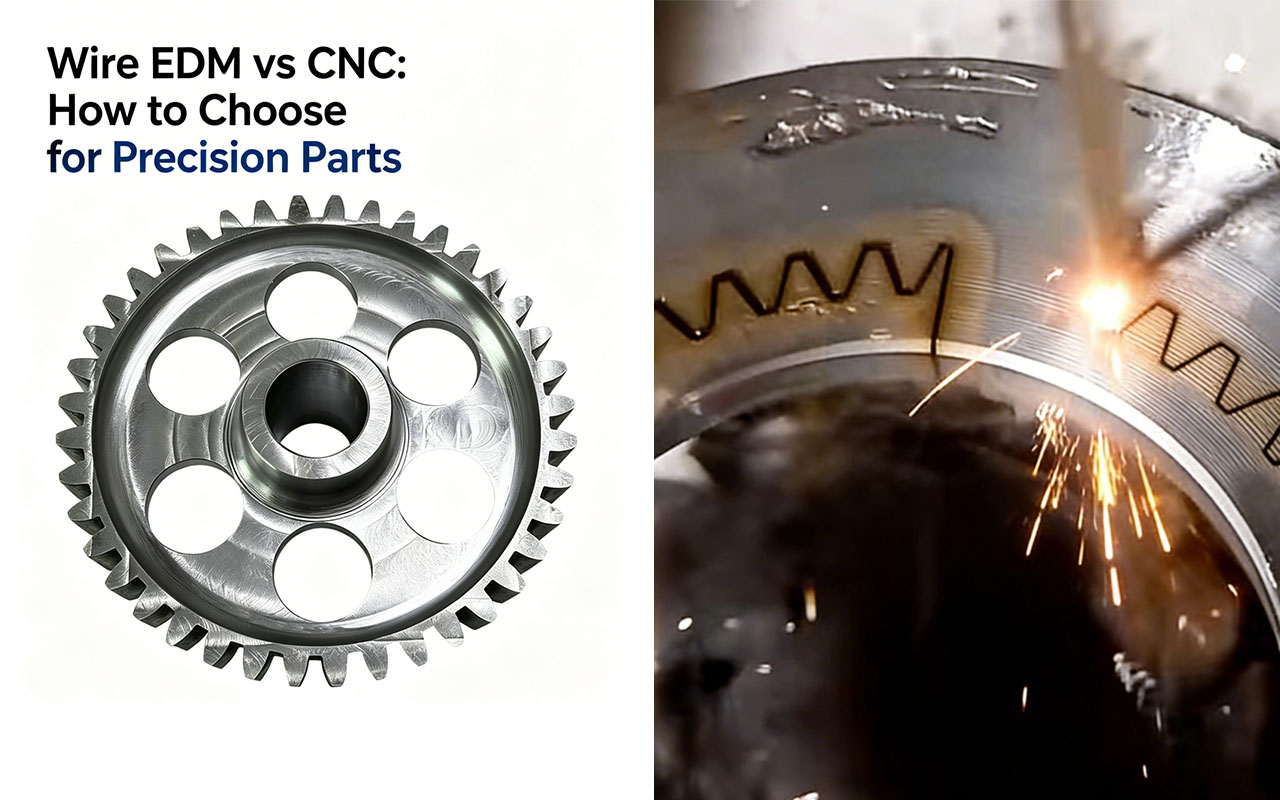
Instead of cutting with a tool, wire EDM uses a thin metal wire (0.1–0.3 mm diameter) for electrical discharge machining. High voltage between the wire and workpiece generates sparks that melt and vaporize the metal locally, achieving the cut. The entire process occurs underwater, with no cutting tool or cutting force involved.
Key characteristics from this principle:
- Only conductive materials can be machined (aluminum, stainless steel, titanium, hardened steel, and cemented carbide work; engineering plastics do not).
- Only through holes and external profiles can be made (the wire is vertical, cutting through the workpiece in the Z-axis direction; it cannot make blind holes, steps, or curved surfaces).
- No cutting force (thin parts will not deform due to clamping pressure).
- Hardness does not affect efficiency (cutting HRC62 hardened steel is as fast as cutting aluminum alloy).
🌟Parts Suitable for Wire Cut
- Precision holes in hard materials:For hardened mold steel above HRC60, CNC tools wear extremely quickly, making it difficult to maintain accuracy. Wire cut, which does not rely on tools, is unaffected by hardness. It can achieve hole accuracy of ±0.003 mm and surface roughness Ra 0.4 μm – something CNC cannot do on hard materials.
- Right-angle profiles and narrow slots:CNC milling typically leaves an internal corner radius of at least R0.5 mm (limited by tool diameter). With a wire diameter of only 0.1–0.3 mm, wire cut can achieve internal radii of R0.05–0.1 mm, close to perfect right angles. Precision stamping dies and mating parts requiring sharp corners must use wire cut.
- Thin-walled parts (< 2 mm thick):CNC milling exerts cutting force, making thin parts hard to clamp or prone to deformation when clamped. Wire cut, with no cutting force, can easily process 0.5 mm thick metal sheets with far better accuracy and stability than milling.
- Complex 2D profiles:Cam profiles, irregular through holes, precision gaskets, and any arbitrary 2D shape in the XY plane can be cut in one pass with wire cut, offering high accuracy and efficiency.
What Wire Cut Cannot Do
- Blind holes, stepped holes, and countersunk holes (wire cut only makes through holes).
- 3D curved surfaces (the profile cut by wire EDM is perpendicular to the Z-axis, with no curves).
- Non-conductive materials like engineering plastics (cannot generate sparks).
- External cylindrical surfaces and threads (these are applications for turning).
For parts with steps, curves, or threads, CNC is the primary process, and wire cut can only serve as an auxiliary operation.
🌟Choosing Between High-Speed and Low-Speed Wire EDM
There are two main types of wire cut, with significant differences in precision:
- High-speed wire cut (WEDM-HS): Accuracy ±0.01–0.02 mm, surface roughness Ra 2–3 μm, low cost. Suitable for low-precision molds and fixtures.
- Low-speed wire cut (WEDM-LS): Accuracy ±0.002–0.005 mm, surface roughness Ra 0.1–0.4 μm, high cost. Precision mating parts and mold cavities require low-speed wire cut.
When specifying precision requirements on drawings, always explicitly state "low-speed wire cut," not just "wire cut." Manufacturers may use high-speed wire cut otherwise, resulting in vastly different accuracy.
Best Practice: Combine Both Processes
The most common and effective process route for precision molds and parts is: CNC roughing (high efficiency for bulk material removal) + Low-speed wire cut finishing of cavities (high accuracy, no deformation from cutting force)
This leverages the strengths of both processes, delivering better results than using either alone.