Industry Knowledge, Surface Treatment Related

Electrophoretic Coating Powder Coating vs. Single Powder Coating: Cost and Effect Comparison Table

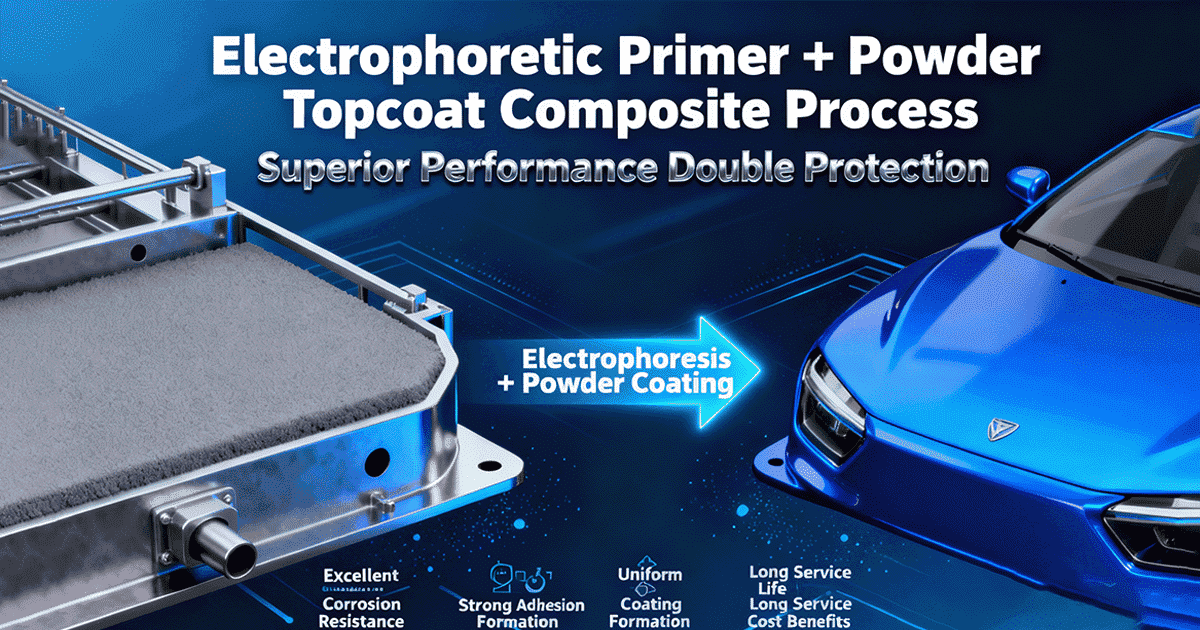
The core advantage of electrophoretic coating combined with powder coating (i.e., the composite process of "electrophoretic primer + powder topcoat") is that it achieves both extreme protective performance and high-quality appearance. Compared with single powder coating, it is more comprehensive in terms of performance and adaptability, which is specifically reflected in the following four aspects:

powder coating

I. Exponential Improvement in Protective Performance

  • Electrophoretic primer: It has strong compactness and extremely high adhesion (Grade 0 in cross-cut test). It can penetrate deep holes and gaps of parts to form a "rust-proof base layer" with salt spray resistance of more than 1000 hours, fundamentally preventing the intrusion of corrosive media.
  • Powder topcoat: It has high hardness (≥2H), good scratch resistance and impact resistance, forming a "physical protective outer layer".
  • Composite effect: The two coatings work synergistically, and the salt spray resistance test generally reaches 1500-2000 hours, far exceeding that of single powder coating (conventional 500-1000 hours). It is especially suitable for parts used outdoors for a long time or in acid-base environments (such as construction machinery and marine equipment accessories).

II. Better Coating Adhesion and Durability

  • Single powder coating relies on the surface pretreatment of workpieces. Parts with complex structures or poor materials are prone to coating peeling and lifting.
  • The electrophoretic primer can form a chemical bond with the metal substrate, and the powder topcoat can closely adhere to the electrophoretic layer. The bonding force between the two layers is strong, so it is not easy to delaminate or peel off even under long-term vibration and temperature changes. Its service life is more than 50% longer than that of single powder coating.

III. Adaptable to Complex Structures with Full Coverage

  • Single powder coating is prone to missing coating or thin coating in deep holes, closed cavities and narrow gaps, resulting in protective blind spots.
  • The electric field deposition characteristics of electrophoretic process can realize uniform full-surface coverage, first solve the protective dead corners of complex structures, and then unify the appearance through powder topcoat, which not only ensures internal rust prevention but also takes into account external decoration. It is suitable for precision parts with complex structures (such as automobile chassis parts and hardware mechanical components).

IV. More Flexible Appearance Texture and Functionality

  • Although single powder coating has rich colors, the flatness of the coating is greatly affected by pretreatment, and particles and sagging are easy to appear on the surface of complex parts.
  • The electrophoretic primer can fill the tiny defects of the substrate, provide a flat base for powder coating, make the color of the topcoat more uniform and the gloss higher (can achieve matte, high gloss, texture and other effects). At the same time, special appearances can be achieved by adjusting the color of the electrophoretic primer and matching with the powder topcoat, taking into account both protection and design requirements.
texture powder coating
Downlight Shade Machining_press machine