

Blog
How many processing methods are there for Mylar insulating parts?

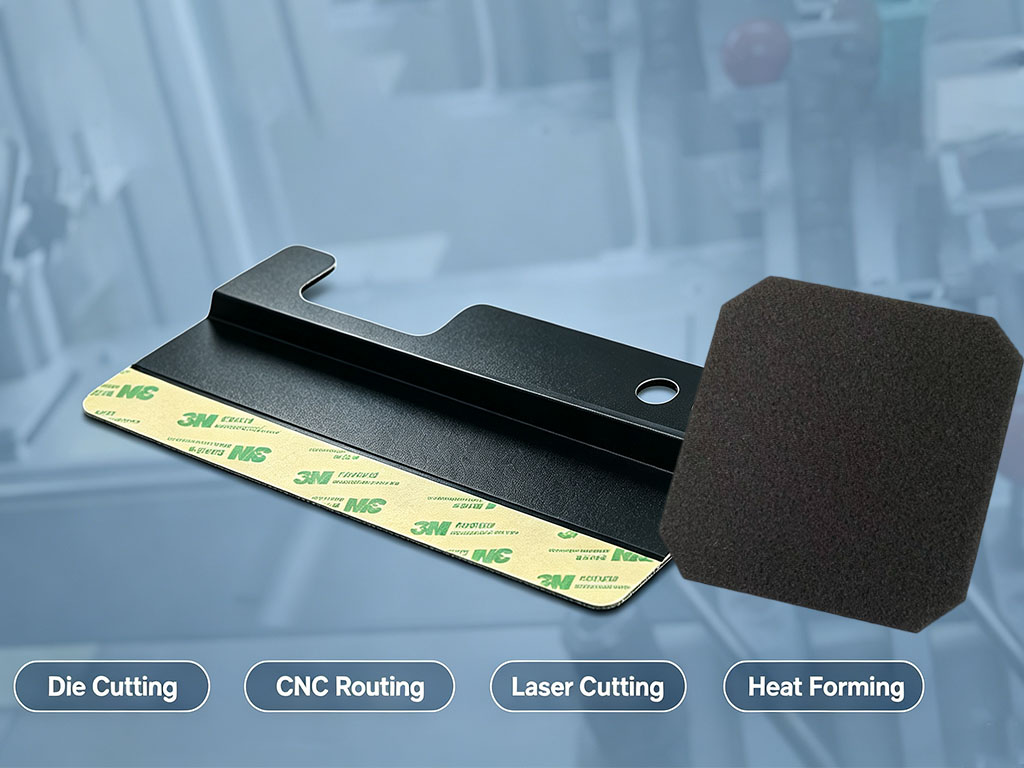
Mylar/Formex Insulation Parts: How Many Processing Methods Are There?
Have you ever encountered this situation when sourcing small-batch Mylar parts? For identical components, you may receive vastly different quotations: one supplier offers USD 5 per piece, while another quotes USD 15 for the exact same part.
- Different fabrication routes (the primary cause of large price gaps)
✅ $5 Option: Die-cut prototyping / Laser cutting
No high-cost tooling required, suitable for simple geometries. Drawback: Thick Formex only undergoes score-line cold bending without heat forming, so bent sections tend to spring back.
✅ $15 Option: CNC Routing + Heat forming
Requires programming and custom bending fixtures with more processing steps. This method delivers permanently fixed bend angles and stable dimensions, ideal for customers’ long-term assembly applications.
How to Choose the Right Processing Method for Your Mylar / Formex Insulation Parts?
Quick Decision Checklist
- Low volume, frequent design changes → Laser Cutting / CNC Routing
- High volume, simple flat or pre-scored parts → Die Cutting
- Thick Formex with permanent folds → CNC Routing + Heat Forming
- Self-adhesive parts for mass production → Die Cutting + Inline Lamination
Mylar and Formex are widely used electrical insulation films in electronics, EV batteries, power supplies, and appliances. There are several practical processing methods to cut these films into precise gaskets, spacers, and shields. This guide explains each method, when to use it, tolerances, finish quality, lead time, and cost.
Main processing methods
1. Die Cutting
2. CNC Routing
3. Laser Cutting
4. Heat Forming
Auxiliary Finishing Process: Lamination
Adhesive lamination is a common secondary operation rather than a primary forming process. Manufacturers bond double-sided tapes (3M 468MP, 9448A etc.) onto Mylar/Formex substrates for self-adhesive installation.Lamination can be integrated inline with die cutting or completed as a separate step after CNC/laser processing. It seems there are multiple available processing technologies for Mylar and Formex insulation parts. In commercial mass manufacturing, however, only two methods dominate formal production: die cutting and CNC routing.

Which has higher cost
- Small batches/prototyping: CNC usually has lower total cost (no die cost). Unit price is higher, but the small quantity makes the overall spend lower.
- Medium to large batches: Die cutting is cheaper (despite die cost). Lower unit price and higher efficiency yield the lowest total cost after amortization.
- Rough break-even point: When cumulative order quantity reaches several hundred to a few thousand parts (depending on die cost, machine-hour price difference, and nesting/yield), die cutting becomes more economical.
Comparison table first to clarify key points, followed by selection and cost recommendations.
| Dimension | CNC Machining | Die-Cutting Process |
|---|---|---|
| Suitable batch size | Prototyping, small batches, frequent revisions | Medium to large batches, stable mass production |
| Upfront setup cost | None or very low (no die cost) | Die cost required (hundreds to tens of thousands RMB, depending on shape complexity/size) |
| Unit cost | Relatively high (longer machining time) | Relatively low (fast cycle time, high material utilization) |
| Lead time | Fast (same day/next day) | Die fabrication takes 1–3 days; fast delivery after ramp-up |
| Tolerance capability | Typically ±0.05–0.10 mm | Typically ±0.1–0.15 mm (can be better with high-precision tooling) |
| Edge quality | Knife: clean; Laser: possible slight yellowing/melt edge | May show slight rollover/burrs, controllable |
| Shape complexity | More flexible for complex profiles and tiny holes (laser/knife path easily changed) | Higher complexity significantly increases die cost and setup/debug time |
| Material/thickness | Works from thin films to medium-thick sheets; less efficient on thick/rigid sheets | Extremely efficient for thin films (incl. adhesive-backed); thick/rigid materials require high tonnage or are unsuitable |
| Laminates/adhesive | Possible (CNC knife/laser kiss-cut), average efficiency | Excels at kiss-cut (half-cut), waste removal, and registration |
| Repeatability | Stable but depends on equipment/fixturing | Excellent (stable tooling, consistent cycle) |
| Revision flexibility | Very flexible; change the program | Requires reworking/remaking the die; higher cost and time |
Which has higher cost
- Small batches/prototyping: CNC usually has lower total cost (no die cost). Unit price is higher, but the small quantity makes the overall spend lower.
- Medium to large batches: Die cutting is cheaper (despite die cost). Lower unit price and higher efficiency yield the lowest total cost after amortization.
- Rough break-even point: When cumulative order quantity reaches several hundred to a few thousand parts (depending on die cost, machine-hour price difference, and nesting/yield), die cutting becomes more economical.
Quick selection guidelines
Choose CNC in these scenarios:
- Prototyping/pilot runs/frequent design iterations
- Highly complex outlines or many variants in small quantities
- Tiny features or local fine-tuning (e.g., adjust for assembly interference)
- Rush orders requiring same-day shipment
Choose die cutting in these scenarios:
- Stable mass production (>hundreds/thousands of pieces)
- Adhesive-backed Mylar/Formex parts needing kiss-cut and easy waste removal
- Multi-cavity parallel cutting, high consistency and throughput
- High sensitivity to material utilization and unit cost
Conclusion
- Small batches/rapid iteration/complex shapes: prioritize CNC.
- Medium–large batches/adhesive-backed/high consistency and low unit price: prioritize die cutting.
- If repeat orders and volume growth are expected, start with CNC for samples and small batches, then switch to die cutting after design freeze for the best overall cost and schedule.
If you share the exact dimensions, thickness, adhesive or not, batch size, and target tolerance, I can recommend the process route, estimate die cost and unit price, and provide nesting advice.