Industry Knowledge, Surface Treatment Related

Design Limitations and Handling Solutions for Non-Overall Powder Coating of Powder-Coated Parts

Powder coating is a common surface treatment method for sheet metal and other parts due to its controllable cost and strong protective performance. However, some parts are difficult to achieve overall powder coating due to design structure constraints. Such design limitations mostly stem from special structural requirements, requiring targeted optimization to balance process feasibility and product performance.

I. Core Design Reasons for Inability to Achieve Overall Powder Coating

  1. Closed or semi-closed cavity structure: The internal part has deep cavities, blind holes, or closed spaces. Powder cannot adhere evenly, and excess powder is difficult to discharge after coating, which is prone to accumulation or missing coating.
  2. High-precision mating surface design: Some parts include interfaces, threaded holes, or positioning surfaces that require tight assembly. Overall powder coating will increase the surface thickness, affecting assembly accuracy or functional use.
  3. Integration of special materials or components: The part is equipped with high-temperature-intolerant plastic parts, electronic components, or areas that need to maintain electrical conductivity. Overall powder coating will damage the functions of these components.

II. Targeted Handling Solutions

  1. Design optimization and adjustment: Improve non-critical structures, such as opening process holes in closed cavities to facilitate powder circulation and recovery. Reserve sufficient machining allowance for high-precision mating surfaces, and ensure accuracy through secondary processing after powder coating.
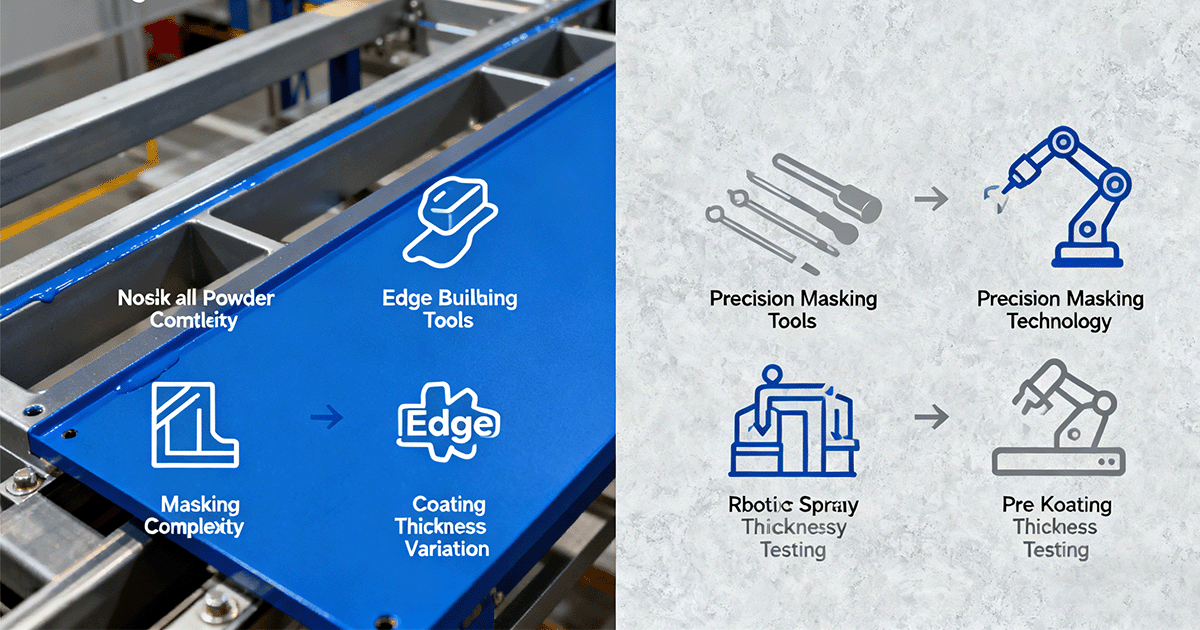
  2. Local masking protection: Use high-temperature-resistant tape, silicone plugs, masking films, and other tools to seal and protect areas that do not require powder coating. Remove the masking materials after coating completion, which is suitable for local protection needs such as threaded holes and conductive areas.
 
powder coating

3.Split coating and reassembly: Disassemble the part into independently powder-coatable components, complete the coating separately, and then assemble. This avoids the limitations of closed structures or special components on the powder coating process. It is necessary to confirm the sealing and structural strength after assembly in advance.

4.Alternative process complementation: For local areas that cannot be powder-coated, use electrophoresis, spray painting, and other processes for supplementary treatment, or directly select materials with inherent protective performance to ensure that the overall protection requirements of the part are met.

The process adaptability of powder-coated parts should be comprehensively considered in the initial design stage. Through structural optimization, process combination, and other methods, the problem of non-overall powder coating can be effectively solved, ensuring both the surface treatment effect and the design function and service performance of the part.