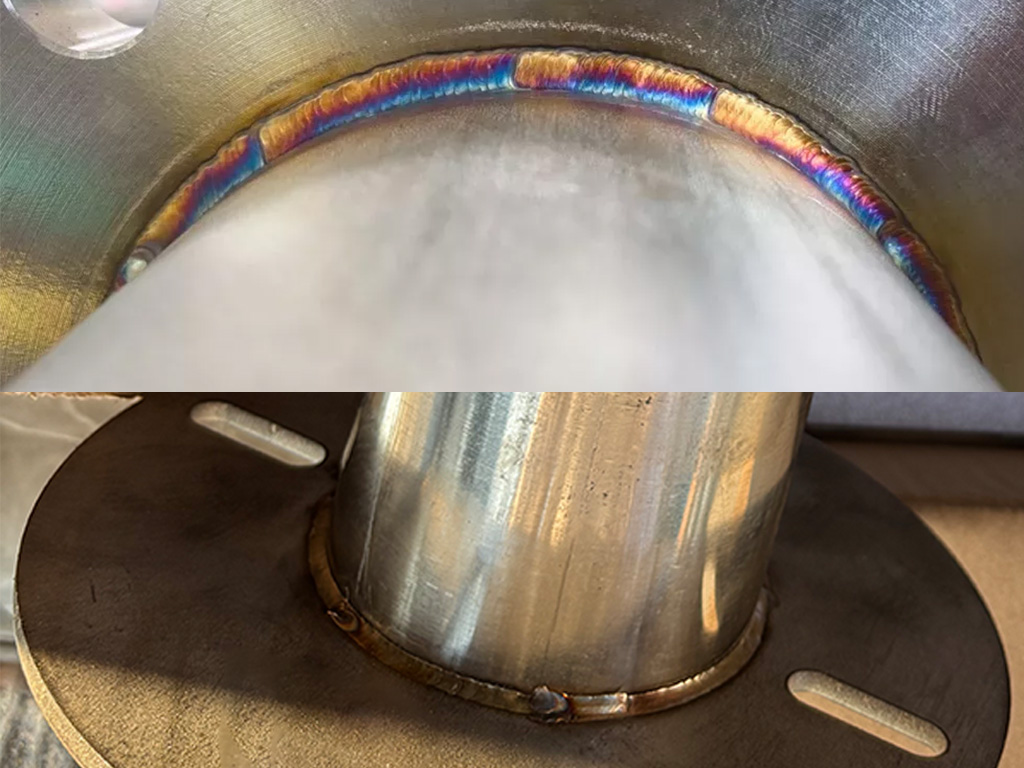
If you run a welding repair, fabrication, or stainless steel welding business, you’ve probably wondered:
Is a blue or purple TIG weld bead a sign of good penetration and quality?
Many welders believe colorful welds equal strong welds—but this common belief is often inaccurate.
In this guide, we explain what stainless steel TIG weld colors actually mean, how discoloration impacts corrosion resistance, and how to produce clean, high-quality welds that last.
🌟What Causes Stainless Steel TIG Weld Discoloration?
When TIG welding (GTAW) stainless steel, 100% argon is used as shielding gas. Its job is to block oxygen, nitrogen, and moisture in the air from contaminating the weld pool.
Discoloration—from straw yellow to purple, blue, or black—forms when:
- The weld area is exposed to oxygen during cooling
- Heat input or travel speed is unbalanced
- Shielding gas coverage is weak or turbulent
- There is insufficient back purging
The darker the color, the higher the oxidation and the greater the risk to corrosion resistance.
🌟Do Blue & Purple Weld Beads Mean Good Penetration?
No.
A blue or purple color in your TIG weld bead does not guarantee good penetration.
Weld color is a sign of
oxidation and heat exposure, not penetration depth.
You can have full penetration with a clean, bright weld—and you can have deep blue or purple beads with poor shielding and reduced corrosion resistance.
🌟How Weld Discoloration Hurts Stainless Steel
Stainless steel relies on a
thin, passive chromium oxide layer for corrosion resistance.
Welding discoloration creates a thicker, unprotective mixed oxide layer that:
- Reduces corrosion resistance
- Can lead to pitting and crevice corrosion
- Creates chromium-depleted zones near the weld
- Lowers performance in marine, food, medical, and outdoor environments
Severe discoloration called “sugaring” (black, grainy, burnt areas) happens when thin material is unprotected during welding.
🌟How to Reduce Weld Discoloration & Improve Quality
Follow these steps to minimize oxidation and preserve corrosion resistance:
- Use clean, consistent argon shielding gas
- Install a gas lens for stable, laminar flow
- Use back purging (argon or nitrogen) for tubes and thin parts
- Control heat input & travel speed
- Use a trailing gas nozzle for extended protection
- Remove heat tint after welding
🌟How to Remove Weld Discoloration
If discoloration appears, you can restore corrosion resistance using:
- Mechanical cleaning: Brushing, grinding, sandblasting
- Chemical cleaning: Pickling
- Electrochemical methods: Electropolishing, electrolytic cleaning
For critical applications (food equipment, marine, medical), all heat tint should be removed.
Conclusion
Blue and purple TIG weld beads look impressive, but they are
not proof of good penetration.
Weld color shows oxidation levels—not weld strength.
The goal of quality stainless steel TIG welding is:
- Full penetration
- Clean, minimal discoloration
- Strong corrosion resistance
- Proper shielding and post-weld cleaning
If you own a welding repair or fabrication shop, understanding weld colors will help you produce stronger, longer-lasting stainless steel parts for your customers.